
Quick Labour Law Facts
- Gratuity: based on basic salary (21 days per year for the first 5 years, then 30 days)
- Maximum cap (MOHRE/mainland): up to 2 years’ basic salary (some jurisdictions differ)
- Final settlement timing (MOHRE/mainland): typically expected within 14 days after the last working day (timelines can vary by case/jurisdiction)
- Working hours: up to 8 hours/day, 48 hours/week (subject to role and lawful exceptions)
- Annual leave: 30 calendar days per year after completing 12 months
- Maternity leave: 60 days (45 full pay + 15 half pay)
Use our free Gratuity Calculator UAE to estimate your end-of-service benefits.
Your salary is 47 days late. HR says “next week” for the third time. You check UAE employment law but find conflicting information online. Can you resign and still claim your rights? Will taking it to a labour court in Abu Dhabi or Sharjah take months to resolve?
Or your annual leave request is denied again with no reason given. Across Dubai, Sharjah, and other emirates, thousands of employees face exactly this. Every month, the Ministry of Human Resources and Emiratisation (MOHRE) logs thousands of labour complaints. Delayed pay, denied leave, changed contract terms, and zero-notice terminations are among the most common.
Federal Decree-Law No. 33 of 2021 protects private-sector employees in the UAE. This guide explains your key rights. It covers employment contracts, leave entitlements, salary payment rules, termination procedures, and dispute resolution.
Information Accuracy: This guide reflects UAE labour law and MOHRE regulations reviewed in September 2026. The next review is due in March 2027. Employment rules may vary based on contract terms, free zone jurisdiction, and specific circumstances. For your situation, verify with MOHRE (600 590 000) or consult a qualified UAE labour law attorney.
UAE Labour Law 2026: Your Rights at a Glance
These represent statutory minimums under UAE labour law. Your employment contract cannot legally offer less.
| Your Right | Legal Minimum | Reference |
|---|---|---|
| Contract Type | Fixed-term, no maximum duration | Article 8 |
| Probation Period | Maximum 6 months | Article 9 |
| Annual Leave | 30 calendar days/year | Article 29 |
| Sick Leave | 90 days (tiered payment) | Article 31 |
| Maternity Leave | 60 days (45 full + 15 half) | Article 30 |
| Salary Payment | On the agreed due date through WPS or another approved system | Article 22 |
| Working Hours | 8 hours/day, 48 hours/week | Article 17 |
| Notice Period | 30-90 days (per contract) | Article 43 |
| Final Settlement | Within 14 days | Article 53 |
| ILOE Insurance | AED 5-10 monthly | Decree-Law 13/2022 |
Note: WPS means Wage Protection System. It records salary payments made through approved banks, exchange houses, and financial institutions.
Who Does UAE Labour Law Cover in 2026?
UAE Labour Law (Federal Decree-Law No. 33 of 2021) covers all private-sector employees in the mainland and most free zones, whatever their nationality. It does not cover DIFC, ADGM, government, military, or domestic workers. Each group follows separate rules. Knowing which framework applies is the first step to knowing your rights.
| Jurisdiction | Governing Law | Gratuity System | Who It Covers |
|---|---|---|---|
| Mainland + Most Free Zones | Federal Decree-Law 33/2021 (MOHRE) | 21/30 day formula, 2-year cap | DMCC, RAKEZ, TECOM, JAFZA, mainland companies |
| DIFC | DIFC Employment Law | DEWS funded savings (no lump sum) | Dubai International Financial Centre employees only |
| ADGM | ADGM Employment Regulations 2024 | 21/30 day formula, Annual Basic Wage ÷ 365, no mainland cap, Basic Wage floor of 50% of total Wages | Abu Dhabi Global Market employees only |
| Domestic Workers | Decree-Law 9/2022 | Separate calculation method | Household employees |
TIP: Not sure which law governs your employment? Check your labour card. The issuing authority printed on it tells you whether MOHRE, DIFC, ADGM, or a free zone authority regulates your contract.
Applying the right formula in the wrong jurisdiction can produce a completely different result. See our UAE gratuity calculation errors guide for the checks to make before signing.
Complete MOHRE coverage includes:
✓ All mainland companies registered with MOHRE
✓ All nationalities without any discrimination.
✓ Most free zone employees (as shown in the table above)
✓ Full-time, part-time, remote, and flexible workers, with part-time entitlements calculated on a pro-rata basis.
Not covered by MOHRE:
✗ Public sector employees (civil service regulations)
✗ DIFC employees
(Separate DIFC law)
✗ ADGM employees (separate ADGM regulations)
✗ Military, police, self-employed consultants
What is the “New” UAE Labour Law?
Federal Decree-Law No. 33 of 2021 came into force on February 2, 2022. It replaced Federal Law No. 8 of 1980, which had governed private sector employment before that date. The new law modernized regulations for today’s workforce.
Major updates include:
- Mandatory fixed-term contracts with no maximum length (legacy unlimited contracts had to convert by 31 December 2023)
- Paid parental leave of five working days, usable within six months of birth
- Strengthened Wage Protection System tracking salary payments
- Digital dispute resolution through Twa-fouq Centre
- Explicit workplace anti-discrimination protections
- Two-year limitation period for labor claims from employment termination
Health Insurance and Employee Benefits Under UAE Law
UAE employers must provide two types of mandatory protection: health insurance and end-of-service security. Both are legal requirements, not optional benefits.
Employer-Provided Health Insurance
Employers must provide basic health insurance at their expense under emirate-specific regulations. Premium costs cannot be deducted from your salary. While employers must cover employees, family coverage is not always legally required. Every UAE resident must maintain valid health insurance.
Employees earning at least AED 4,000 monthly basic salary qualify for specific work permit categories. This is based on MOHRE job classification levels.
End-of-Service Benefit Protection
Employers must provide security through either bank guarantee (AED 3,000 per employee) OR insurance policy (Taa-meen). Insurance may cover up to AED 20,000 per employee for unpaid wages, gratuity entitlements, repatriation costs, and work injuries.
ILOE Unemployment Insurance
The Involuntary Loss of Employment scheme covers all private sector employees in the UAE, including expatriates. Domestic workers and business owners are excluded. It provides income protection during involuntary job loss as per details below:
| Aspect | Details |
|---|---|
| Monthly Contribution | AED 5 (salary ≤ AED 16,000) or AED 10 (salary > AED 16,000) |
| Benefits | 60% of basic salary (maximum AED 20,000 monthly) |
| Duration | Three months |
| Eligibility | Requires 12 months continuous subscription before claiming |
Employment Contracts and Probation: UAE Rules 2026

All UAE private sector employment contracts must now be fixed-term. Understanding your contract type directly affects your gratuity calculation and your rights during probation.
For a detailed comparison of limited and legacy unlimited contracts, see our Limited and Unlimited Contract guide.
Fixed-Term Contracts
All employment contracts must specify a definite end date. Since the 2022 amendment, there is no maximum contract length. The employer and employee agree the term. The contract type determines certain benefit calculations. Successive renewals count as continuous service for final settlement and leave purposes. Both parties must provide written consent before renewal.
Probation Period
Maximum probation is six months regardless of position or industry. Employers cannot extend or restart probation after completion. You receive full contractual salary from day one. Reduced probation rates are not permitted.
Notice during probation:
- Employer terminates: 14 calendar days minimum
- Employee resigns to UAE job: 30 calendar days
- Employee resigns leaving UAE: 14 calendar days
Tip: Check your contract for the exact notice period days that apply to you. Your contract terms take precedence over the standard 30 to 90 day range under Article 43.
Can I resign during probation in the UAE?
Yes. During probation provide 30 days written notice for UAE jobs or 14 days if leaving UAE permanently. After probation check your contract. Notice ranges from 30 to 90 days. Always submit written resignation to HR with delivery confirmation.
Working Hours, Overtime, and Compensation
UAE labour law sets clear rules on standard working hours, overtime limits, and when additional compensation becomes payable.
What are Standard Working Hours?
Standard working hours in the UAE are 8 hours per day and 48 hours per week. Employees may work up to 2 more hours as overtime, so the daily total does not exceed 10 hours. Total working hours, including overtime, must not exceed 144 hours in any three-week period. During Ramadan, normal working hours are reduced by two hours daily for private sector employees.
Overtime Pay Rates
Different overtime rates apply depending on when the extra work is performed and whether it falls on a rest day or public holiday, as detailed below:
125%
Regular Overtime
Standard hourly rate
150%
Night Work
10 PM – 4 AM
Day off or 150%
Rest Day Work
Substitute day off, or wage plus 50% premium
Day off or 150%
Public Holidays
Substitute day off, or wage plus 50% premium
Overtime Pay Rates
Senior executives with discretionary hours and certain field workers may be exempt if explicitly stated in contracts. For the full formula, Ramadan rules, and worked AED examples, see our overtime calculation guide.
UAE Leave Entitlements: Annual, Sick, Maternity and More
UAE labour law sets minimum leave entitlements for every private sector employee. Your employer cannot offer less than what the law requires.
Complete Leave Entitlements
The table below sets out the main leave types, eligibility rules, duration, payment status, and legal reference:
| Leave Type | Eligibility | Duration | Payment | Reference |
|---|---|---|---|---|
| Annual | More than 6 months | 2 days/month under 1 year, then 30 days/year | Full pay | Article 29 |
| Maternity | All female staff | 60 days | 45 full + 15 half | Article 30 |
| Parental | Both parents | 5 working days | Full pay | Article 32(1)(b) |
| Sick | Post-probation | 90 days | 15 full + 30 half + 45 unpaid | Article 31 |
| Hajj | Once per employer | 30 days | Unpaid | Employer policy |
| Study | ≥ 2 years service | 10 days | Varies | Article 32(2) |
| Job-search | During notice if terminated | 1 day/week | Unpaid | Article 43(5) |
| Bereavement | All staff | 3-5 days | Full pay | Article 32(1)(a) |
Annual Leave
You receive 30 calendar days paid annual leave per complete year. After one year, you receive 30 days of paid annual leave. If service exceeds six months, you receive two days per month until one year.
Upon termination, you receive cash payment for all unused leave including partial years as below:
Calculation:
Monthly basic salary ÷ 30 × unused days.
Public holidays (approximately 11–13 annually) are separate from annual leave.
See our leave encashment calculator and guide for your calculation, formulas, rules and work examples.
Sick Leave
You receive 90 calendar days sick leave annually with the following salary rules:
15 days
Full Salary
30 days
Half Salary
45 days
Unpaid
Medical certificates from UAE-licensed providers are mandatory. Certificates must include diagnosis, rest duration, facility stamp, and physician details. Work-related injuries follow different rules under Federal Law No. 6 of 2019. The employer covers full medical costs and pays your full salary throughout recovery.
Can I be fired during sick leave?
Generally no, unless serious documented misconduct unrelated to illness. Termination during legitimate sick leave may constitute unfair dismissal.
Maternity and Parental Leave
Female employees receive 60 calendar days of maternity leave. The first 45 days are on full pay. The remaining 15 days are on half pay. Leave can start up to 30 days before delivery with a medical certificate. After returning, the employee gets nursing breaks up to one hour per day for six months (can be split).

Both parents are entitled to 5 working days of parental leave. It can be taken continuously or in separate days within 6 months of the child’s birth.
Hajj and Umrah Leave
Practicing Muslims may receive Hajj leave once during employment with official Hajj permit. Duration 30 days unpaid. Terms vary by employer policy. UAE labour law doesn’t provide separate Umrah leave provision. Employees use annual leave for Umrah or request unpaid leave based on employer approval.
Study Leave and Job-Search Leave
Study leave available for employer-approved education relevant to employment, 10 days annually after two years service. Requires study at UAE-accredited institution. Employees terminated (not resigned) receive one unpaid day weekly during notice period for job searching.
Bereavement Leave
Paid leave for family deaths:
5 days: Spouse death (5 days paid)
3 days: Parent/child/sibling/grandparent death
Salary Payment Rules and Legal Deductions in the UAE
UAE labour law sets clear rules on salary payment, permitted deductions, and what happens when your employer delays pay.
Wage Protection System
Employers must pay wages on the agreed due date. MOHRE-registered employers must use WPS or another approved system. Article 22 and Article 16 of Cabinet Resolution No. 1 of 2022 govern wage payment.
If wages are late, keep your WPS and salary records. Contact your employer in writing. File a MOHRE complaint if the issue remains unresolved.
Currency of Salary Payments
Salaries are paid in UAE Dirhams. Employers and employees may agree on alternative currencies, such as USD, EUR, or GBP. The contract must state this clearly before signing. All salary payments must process through WPS regardless of currency. The contract must clearly specify currency type, exchange rate mechanism, and payment frequency.
What Is Basic Salary in the UAE?
Basic salary is the fixed pay stated in your employment contract. It does not include allowances like housing, transport, or other benefits. UAE labour law does not set a fixed split between basic salary and allowances. Your employer decides this split when drafting your contract. Basic salary matters because it decides your gratuity, leave encashment, and overtime pay. A lower basic salary means a lower payout when you leave your job. Check your contract or MOHRE-attested labour contract to see your exact basic salary. If your basic salary looks low compared to your total pay, ask HR for a clear breakdown before you sign or resign.
Is There a Minimum Wage in the UAE?
The UAE has no general minimum wage set in law for private-sector workers. The AED 4,000 figure you may see is a skilled-worker permit classification threshold, not a universal pay floor. Your salary is set by your contract and must be paid in full and on time through the Wage Protection System.
Legal and Illegal Salary Deductions
✓ Permitted Deductions
- Proportional deductions for absences
- Loan repayments you authorized in signed agreement
- Social insurance/pension contributions
- Court-ordered garnishments
- Documented property damage with your acknowledgment
Note: Total monthly deductions cannot exceed 50% of gross salary except for pre-authorized loan repayments.
❌ Prohibited Deductions
- “Administrative fees” for routine operations
- Arbitrary fines without investigation
- Equipment/tools costs required for work
- Random penalties without documented misconduct
Can Your Employer Change Your Contract Terms?
No. Employers cannot modify contract terms without your written consent. Changes to salary, job title, work location, benefits, or conditions require mutual written agreement registered with MOHRE. Unilateral changes by your employer may constitute a fundamental breach of contract. This can give you grounds to claim constructive dismissal.
Employee Action Checklist – Protect Yourself From Day One

Many employees in the UAE only think about documentation when problems arise. By then, crucial evidence may be lost. This checklist helps you build a paper trail that protects your rights under UAE employment law from your first day.
Documents to Save Immediately
Keep digital copies of these documents in personal cloud storage (not your work computer):
- Signed employment contract with basic salary, allowances, and notice period clearly stated
- MOHRE-attested labour contract (this takes precedence if terms differ)
- Emirates ID copy and visa page showing your sponsor
- Work permit or labour card from MOHRE or your free zone authority
- Salary breakdown showing basic versus total package
Monthly Habits That Protect You
Build these simple habits to keep a clean record month by month:
- Screenshot your leave balance from the HR portal each month
- Save every payslip in PDF format with clear dates
- Export attendance records if your company uses digital timesheets
- Log any verbal agreements by sending a follow-up email:
“As discussed today, [summary].
Please confirm.”
Red Flags Requiring Immediate Documentation
If any of the following happens, document these immediately:
- Verbal promises without written confirmation — follow up important discussions in writing
- Requests to sign backdated or unread documents — never sign under pressure
- Salary arriving later than usual — note dates and keep bank statements
- Contract amount differs from actual salary — document the discrepancy as it affects your final payout
- Unsigned contract amendments — any changes must be in writing and signed by both parties
What Action to Take
Use these steps as soon as an issue appears, before it escalates:
- Raise issues with HR first, then follow up in writing to create a record
- If informal resolution fails, file a complaint through MOHRE’s app, website, or call 80084
- Free zone employees should contact their free zone authority first before escalating to MOHRE
- For claims involving significant amounts or complex issues like wrongful termination, consider seeking legal advice
Note: Complaint filing deadlines and procedural timelines vary by case and authority. Check MOHRE’s official channels or consult a labour lawyer for guidance specific to your situation.
UAE Termination Rules and Notice Period Rights
Your notice period and termination rights depend on your contract terms and the reason for leaving. Both resignation and termination carry specific obligations under Article 43 of Federal Decree-Law No. 33 of 2021.
Notice Requirements
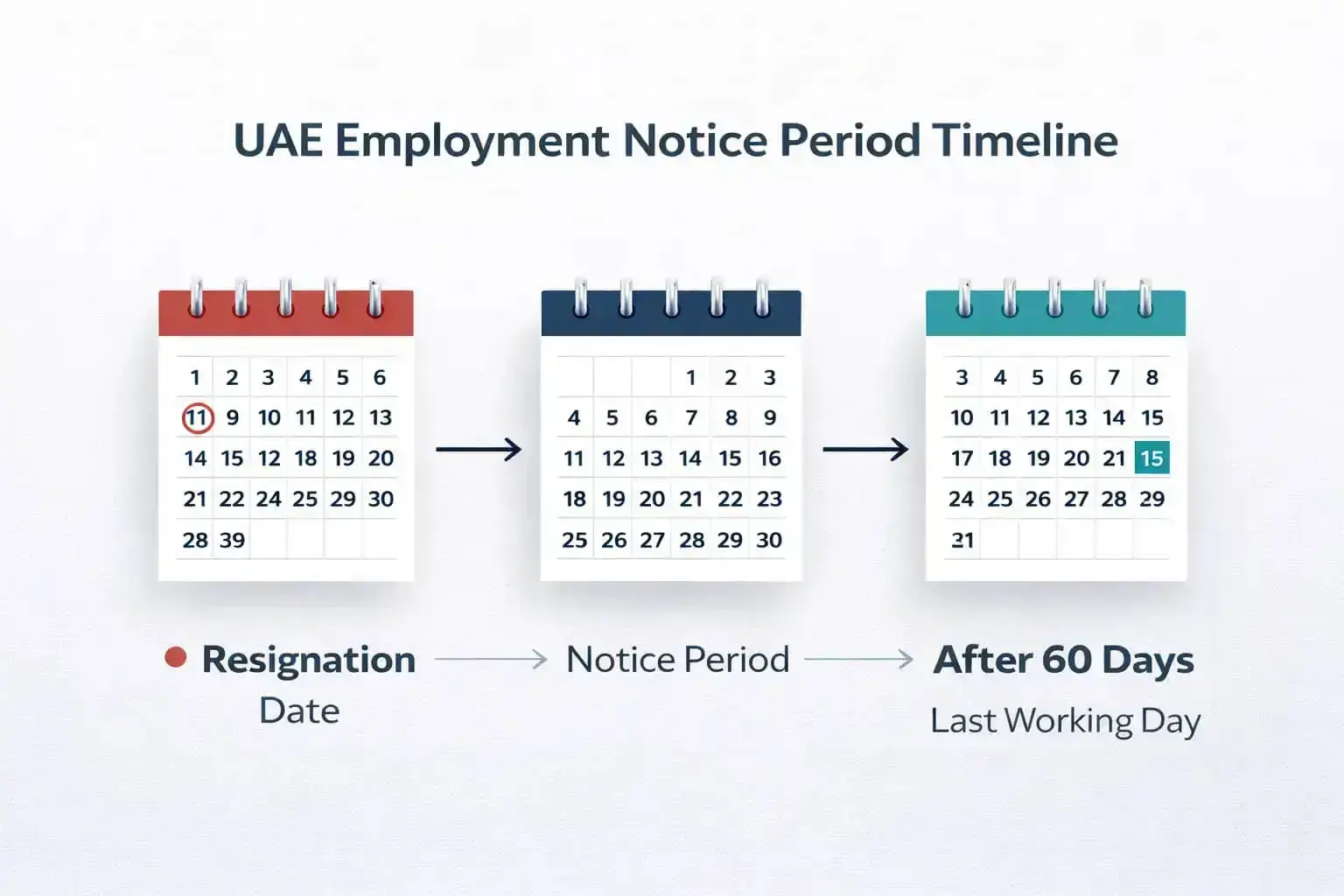
Notice periods range from 30 to 90 days depending on contract terms. Check your signed contract for exact requirements. Written resignation is mandatory. Email to HR with confirmation is acceptable. If you are preparing to resign, see our UAE resignation letter templates for examples covering normal notice, probation and requests for a shorter notice period. Notice begins the day after employer receives resignation. Use the UAE Notice Period Calculator to confirm your last working day and settlement deadline before you resign.
Options during notice:
- Payment in lieu: Employer pays full notice salary, releases immediately
- Buy-out: You pay employer for unserved days with agreement
- Garden leave: Employer pays you to stay home during notice
Disciplinary Procedures
Employers must follow progressive discipline:
- Verbal warning (documented in file)
- Written warning for repeated violations
- Salary deduction (maximum 5 days monthly)
- Temporary suspension (up to 30 days on half pay)
- Termination for serious misconduct with due process
Contract Suspension During Investigation:
Employers may suspend employees for up to 30 days on half pay during formal investigations. If investigation finds innocence, employer must pay remaining half salary. Your employer must provide written notice of the suspension and the reasons for investigation.
For the full comparison of how resignation and termination affect your gratuity, notice pay, and Article 47 compensation, see our Termination vs Resignation guide.
Your Gratuity Entitlement When Leaving
Complete at least one year of continuous service and you generally qualify for an end-of-service benefit (gratuity). The calculation uses your last basic salary under UAE employment law. If your employer used a CTC-format offer letter, your MOHRE contract basic salary is the only figure that applies. See our guide to CTC and gratuity in UAE if the two figures differ. Unpaid leave days do not count toward your gratuity service period under Article 51(4). This reduces your total eligible service time and affects your final EOSB amount. In MOHRE-regulated workplaces, final settlement is typically due shortly after your last working day. Timelines can vary by case, documentation status, and the authority involved. This includes certain free zones.
For quick answers on eligibility, resignation, and final settlement, see our UAE Gratuity FAQ.
Our Gratuity Calculator, follows UAE labour law. It shows the formula used, year-wise breakdown of your payout—all in a few clicks.
The Employer Fund Option: How It Works
The Voluntary End-of-Service Savings Scheme UAE lets employers replace traditional gratuity with monthly fund contributions. Introduced under Cabinet Resolution No. 96 of 2023, it builds your benefit during employment instead of paying a lump sum when you leave.
If your employer has enrolled, the standard Article 51 gratuity formula does not apply to you. Your final benefit depends on your accumulated fund balance. Confirm with HR and check your balance directly with the scheme provider.
NOTE: If your employer uses this scheme, the UAE gratuity calculator on this site does not apply to your situation. Verify with HR before relying on any calculated figure.
Final Settlement Review Checklist
Do not accept or sign any “full and final” document straight away. Ask HR for a written line-by-line settlement breakdown first. Check each amount before you sign.
Check settlement includes
- Unpaid salary up to the last working day
- Unused annual leave encashment
- Any notice pay or notice deductions
- Approved reimbursements not yet paid
- A clear list of any deductions
Verify these items first
- Last working day matches your records
- Leave balance matches the HR portal
- Deductions are itemized and supported
- Notice treatment is consistent
- Payment timing and method are stated
Important: Do not sign wording such as “received in full and final settlement” or “no further claims” until the breakdown matches your records.
If you find an error, reply in writing. Request a corrected sheet showing revised dates, balances, and the basis for each deduction. If the settlement stays unpaid after written follow-up, escalate through MOHRE. Use the Gratuity Application Letter Generator to send a formal written demand before filing. Submit your contract, payslips, WPS or bank proof, and the settlement sheet.
UAE Job Levels Classification
MOHRE classifies all jobs into nine professional levels determining skill categories, visa requirements, and work permit eligibility.
| Level | Category Description |
|---|---|
| Level 1 | Legislators, Managers, and Business Executives |
| Level 2 | Professionals in Scientific, Technical, and Human Fields |
| Level 3 | Technicians in Scientific, Technical, and Humanitarian Fields |
| Level 4 | Writing Professionals |
| Level 5 | Service and Sales Occupations |
| Level 6 | Skilled Workers in Agriculture, Fisheries, Animal Husbandry |
| Level 7 | Craftsmen in Construction, Mining, and Other Crafts |
| Level 8 | Machine and Equipment Operators and Assemblers |
| Level 9 | Basic Occupations / Helping Hands |
Skilled work classification has four requirements. The job must fall within Levels 1–5. The worker must hold a certificate or degree above high school level, officially attested. The minimum monthly salary is AED 4,000.
UAE Public Holidays and Premium Pay Rules 2026
UAE observes paid public holidays annually. Islamic holiday dates depend on lunar calendar moon sighting announcements.
| Holiday | Days | Date/Period |
|---|---|---|
| Gregorian New Year | 1 day | January 1 |
| Eid Al-Fitr | 3-4 days | Lunar varies |
| Arafat Day & Eid Al-Adha | 3-4 days | Lunar varies |
| Hijri New Year | 1 day | Lunar varies |
| Prophet’s Birthday | 1 day | Lunar varies |
| Commemoration Day | 1 day | December 1 |
| National Day | 2 days | December 2-3 |
Working holidays requires alternative day off within 30 days OR 150% premium pay.
Workplace Rights: Anti-Discrimination and Equal Treatment UAE

UAE labour law protects every employee from discrimination, harassment, and unsafe conditions. These rights apply regardless of nationality, gender, or role.
Anti-Discrimination Protections
UAE labour law explicitly prohibits workplace discrimination. Employers cannot discriminate based on race, color, gender, religion, nationality, social origin, or disability.
Key protections
- Equal pay for equal work
- Cannot terminate due to pregnancy or maternity leave
- Employers must provide reasonable workplace accommodations
- All employment decisions must be merit-based
Harassment and Workplace Safety
Employers are legally responsible for preventing harassment, bullying, verbal abuse, physical violence, and psychological harm. All employees have right to safe, respectful work environment free from intimidation.
Workplace Health and Safety
Employers must provide safe working environments per Federal Law No. 6 of 2019. Requirements include risk assessments, free safety equipment, training, safe premises, and injury reporting.
Midday break protection
Outdoor work is prohibited from 12:30 PM to 3:00 PM during June 15 to September 15 annually.
Work injury entitlements include medical cost coverage, salary throughout recovery, and unaffected gratuity rights.
Non-Compete Agreements
Non-compete clauses must meet reasonableness standards. Valid restrictions require limited duration (maximum two years), reasonable geographic scope, and explicit written terms protecting legitimate business interests only.
Emiratisation: Does It Affect Expat Employees?
No. Emiratisation does not reduce an expat employee’s labour rights. Your gratuity, notice period, leave entitlements, and WPS salary protections all remain governed by Federal Decree-Law No. 33 of 2021. Emiratisation sets hiring quotas for employers. It does not alter, reduce, or override any right in your existing employment contract.
Companies with 50 or more employees must meet annual Emiratisation targets set by MOHRE. Companies that miss targets pay monthly contributions to the Nafis program. If a company misses its targets, the penalty falls on the employer. It does not affect your entitlements as an existing employee.
Common Labour Law Myths Debunked
Understanding the difference between widespread misconceptions and actual legal requirements helps you protect your employment rights. Here are the most common myths with verified facts and official sources.
“Employer can reduce my salary anytime”
Salary reduction requires the employee’s written consent and MOHRE registration. Unilateral reduction is a breach of contract.
Article 38, FDL 33/2021“No gratuity if I resign before 5 years”
Gratuity is generally payable after completing one year of service for fixed-term contracts, subject to lawful exclusions.
Article 51, FDL 33/2021“Probation period can be extended to 12 months”
Probation is capped at six months and cannot be extended or restarted after completion.
Article 9, FDL 33/2021“Unused annual leave expires each year”
Unused annual leave is payable in cash upon termination, including partial years (calculation rules apply).
Article 29, FDL 33/2021“Overtime has no limits if I agree in writing”
Overtime is subject to statutory limits; employee agreement does not remove legal caps.
Article 17 & 19, FDL 33/2021“Employer can deduct training costs from final salary”
Training cost recovery is not automatic. Any deduction normally requires a valid written arrangement and must comply with the law.
Article 55, FDL 33/2021Verification: All facts verified against official UAE Federal Decree-Law No. 33 of 2021 as published on u.ae government portal and MOHRE official guidance.
Another common confusion is the word “gratuity” itself. Under UAE Labour Law, gratuity means an end-of-service benefit paid by the employer when employment ends. It is not the same as a customer tip paid for service. For a simple explanation, read our guide on the difference between gratuity and tip.
How to Resolve a UAE Labour Dispute: MOHRE Process
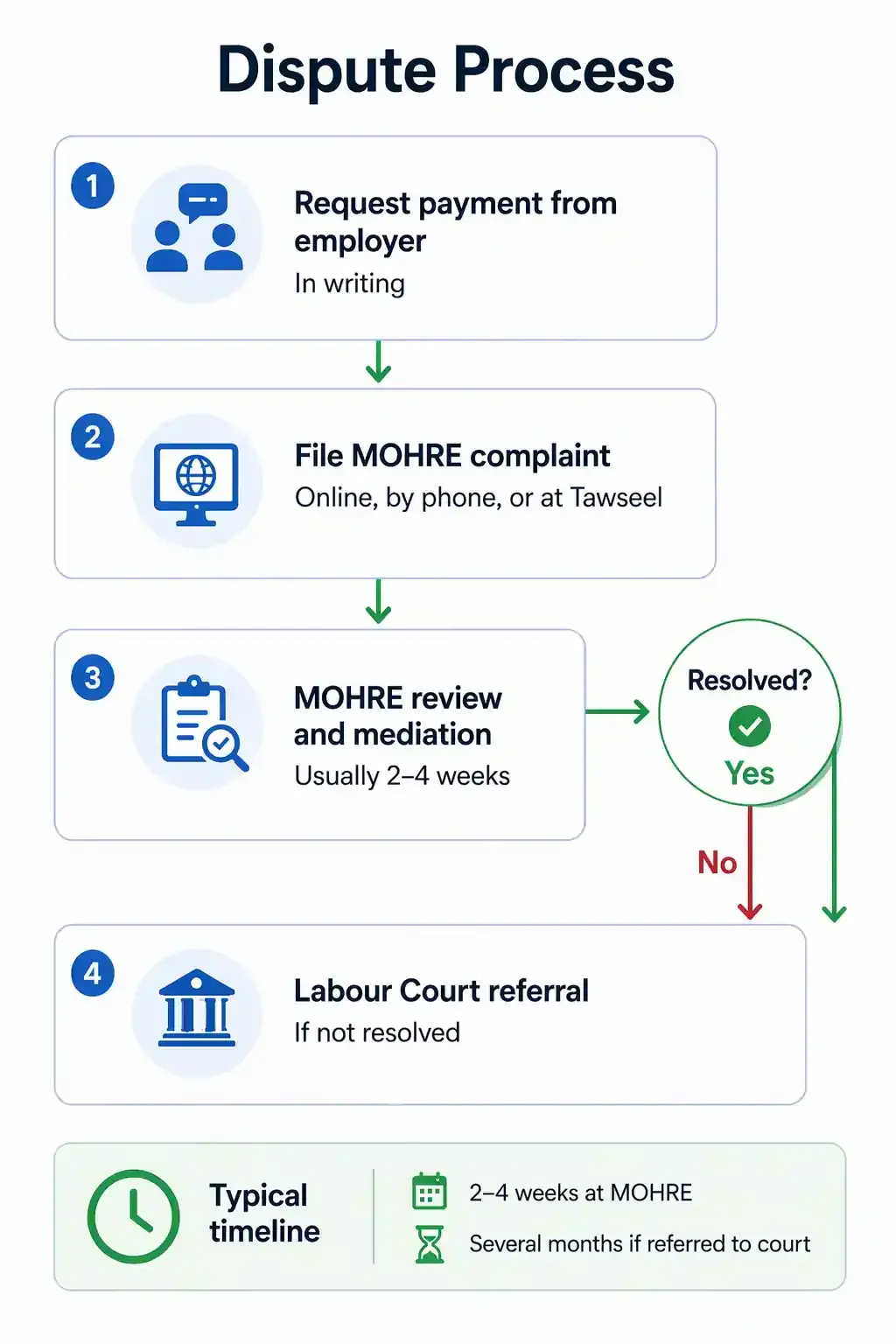
Follow these steps in order.
- Try internal resolution first. Address with HR in writing. State problems clearly, and document all communications.
- If not resolved, file through MOHRE e-services with Emirates ID. Keep the contract, WPS records, evidence, and a timeline. Mediation timelines vary by case. Call MOHRE on 600590000 (general), 80084 (labour claims), or +971 6 803 4000 (international). File online at mohre.gov.ae.
- MOHRE also runs Tawseel mobile vans. These bring complaint filing services directly to workers who cannot reach a service centre.
- For claims of AED 50,000 or less, MOHRE can decide the amount owed and order payment directly. Most cases do not reach the labour court.
- If settlement fails, MOHRE issues a referral certificate. Filing fees and procedures vary by emirate and claim size. Generally filing fees AED 200 to 300. Self-representation permitted for claims under AED 50,000.
Critical evidence to keep: Written contracts, payslips, leave records, email trails, timelines, and witness details (where relevant). Do not delay filing. Article 54(9) sets a two-year limitation period from employment termination.
If your dispute is specifically about an incorrect end-of-service payment, see how to appeal an underpaid gratuity calculation for the evidence checklist, claim-value rules, deadlines, and escalation process.
Frequently Asked Questions
- UAE Federal Decree–Law No. 33 of 2021 — Main private-sector employment law
- Cabinet Resolution No. 1 of 2022 — Executive Regulations under Decree–Law No. 33 of 2021
- UAE Government Portal — Labour relations and private-sector employment guidance
- MOHRE Official Guidance — Official complaint procedures, salary rules, and enforcement guidance
- Federal Decree–Law No. 13 of 2022 — Involuntary Loss of Employment (ILOE) scheme
- DIFC Employment Law — Separate employment regime for DIFC employees
- ADGM Employment Regulations — Separate employment regime for ADGM employees
- Federal Decree–Law No. 9 of 2022 — Domestic workers framework (separate employment regime)
Note: Applicable rules may differ by jurisdiction, including MOHRE, DIFC, ADGM, and specific free zones, as well as by your contract terms.
Protecting Your Employment Rights
Understanding UAE labour law empowers you to recognize violations and claim proper entitlements. Keep comprehensive records from day one. Check MOHRE regularly for legislative changes. Document everything and act promptly.
See What You’re Owed
Use our end of service calculator UAE to estimate what you may be entitled to based on your service period and salary.