
Quick Answer: Resignation is your choice to leave. Termination is your employer’s choice to end your contract. Gratuity survives once you pass 1 year of service. What actually changes is your notice duty, your jurisdiction, and whether Article 44 or Article 47 applies to your case.
Sania works as a marketing executive in Dubai. When her department restructures, her manager suggests she resign instead of being let go. It would “look better” on her record. She almost signs that day.
Had she signed without putting the pressure in writing first, she would have had a harder case later. She would need to show her employer, not her, actually ended things. This mix-up costs UAE employees real money, because termination vs resignation changes what you are legally owed.
This guide breaks down gratuity, notice periods, and compensation for both exit types under Federal Decree-Law No. 33 of 2021. Know what to check before you sign anything.
What Is the Difference Between Termination and Resignation in the UAE?
The core difference in termination vs resignation comes down to who initiates the exit and why it matters legally. That single fact decides your notice duty. It also decides whether Article 47 compensation is even possible.
Both exits are governed by Federal Decree-Law No. 33 of 2021 and its executive regulations under Cabinet Resolution No. 1 of 2022.
Termination vs Resignation at a Glance
| Factor | Resignation | Termination |
|---|---|---|
| Who initiates it | Employee | Employer |
| Standard notice period | 30 to 90 days, as stated in the contract | 30 to 90 days, as stated in the contract |
| Gratuity after one year of service | Full gratuity under fixed-term contracts | Full gratuity as a rule, subject to the Article 44 exception explained below |
| Extra compensation | Not typically available | Article 47 compensation may apply, but only in limited retaliation cases |
| Work permit cancellation | Normally submitted by the employer after the employee’s exit | Normally submitted by the employer after the employee’s exit |
IMPORTANT: If you feel pressured to resign instead of being terminated, document that pressure in writing before you sign anything, and consider checking with MOHRE first. Do not assume this automatically preserves a compensation claim. It depends on the facts.
How Termination and Resignation Affect Your End of Service Gratuity
Under Article 51, gratuity is based purely on length of service, calculated the same way no matter who ends the contract. Most employees qualify for full gratuity after 1 year.
For mainland and MOHRE-aligned employees, gratuity uses 21 days of basic salary for each of the first five years and 30 days for each later year. It is capped at two years of basic salary. ADGM uses Annual Basic Wage ÷ 365 and has no mainland cap.
UAE Gratuity Formula by Length of Service
| Length of Service | Gratuity Entitlement |
|---|---|
| Less than 1 year | No gratuity entitlement |
| 1 to 5 years | 21 days’ basic salary for each year of service |
| More than 5 years | 21 days’ basic salary for each of the first five years, plus 30 days’ basic salary for each additional year |
Legal Basis: Article 51, Federal Decree-Law No. 33 of 2021.
Article 44 gross misconduct dismissal is a separate question this site does not cover in full yet. A normal resignation or ordinary termination does not touch your gratuity at all. See gratuity deductions in the UAE for what an employer can lawfully deduct.
If Article 44 is being used to reduce your gratuity or final settlement, see how to challenge an unfair gratuity calculation and what evidence to keep before filing a dispute.
You can estimate your own payout using the UAE gratuity calculator, which applies this formula automatically based on your join date, exit date, and basic salary. For deeper gratuity mechanics like part-time and probation service, see our UAE Gratuity FAQ.
Does This Apply If I’m Still on an Old Unlimited Contract?
Not fully. If your employer never converted your contract, they may still use the old resignation deduction rules under Article 68(3) of Federal Decree-Law No. 33 of 2021. This is permitted, not required. Under the legacy system, resigning before 5 years reduced your gratuity, a penalty that termination did not carry. Confirm which method your employer actually used.
NOTE: Check your MOHRE-registered contract type before assuming this article’s equal-treatment rule applies to you. See our Limited and Unlimited Contract guide for the full legacy formula and how to confirm your status.
What Happens During the Notice Period in Each Case?
Notice periods apply the same way whether you resign or get terminated, unless misconduct is involved. Article 43 sets the standard range at 30 to 90 days, based on your contract. Who ends the contract does not change this default duration.
The table below covers your options for early release. For the full mechanics, including how notice length affects your gratuity, see our UAE Notice Period guide and calculator.
Notice Period Outcomes
| Scenario | Outcome |
|---|---|
| Employee works full notice. | Normal salary continues, exit proceeds on schedule. |
| Employer waives notice, pays in lieu. | Employee receives full notice period salary immediately. |
| Employee leaves without serving notice. | Employee may owe compensation equal to the unserved notice period. |
| Employer places employee on garden leave. | Full pay continues, employee does not attend work. |
WARNING: If you leave without serving notice and without your employer’s agreement, they can deduct the equivalent salary from your final settlement or pursue a MOHRE claim against you.
How Do Notice Rules Change During Probation?
Yes, and the gap catches many employees off guard. Employer-initiated termination during probation needs 14 days notice. Resignation needs 14 days if you are leaving the UAE, or 30 days if you are joining another UAE employer. Neither termination nor resignation during probation changes these figures.
For the full probation notice breakdown and a calculator to confirm your exact last working day, see our UAE Notice Period guide and calculator.
When Can an Employer Dismiss You Without Notice?
An employer can dismiss you immediately, without notice, only under Article 44 gross misconduct provisions. This is a narrow legal category, not a general excuse for firing someone quickly. Ordinary poor performance or a personality clash with a manager does not meet this bar.
Article 44 covers serious violations only. These include fraud, theft, physical assault in the workplace, disclosing confidential company information, or repeated breaches of workplace rules after written warnings.
Before dismissing you under Article 44, your employer must run a documented investigation and provide a written, reasoned dismissal decision. Gratuity is not automatically forfeited by this dismissal. Withholding it requires a lawful basis, normally established through a court ruling.
NOTE: If you are dismissed under Article 44, request the written dismissal decision, the specific allegations relied on, and copies of any prior warnings.
What Is Unlawful Termination Under Article 47?
Article 47 protects an employee dismissed for filing a serious MOHRE complaint or a valid lawsuit against the employer. It does not cover redundancy or performance-based termination on its own. This is a narrower test than general unfair treatment, so most terminations do not qualify.
If the competent court finds the termination unlawful for this specific reason, it may award compensation not exceeding 3 months of the employee’s last wage, on top of normal gratuity and final settlement. A missed notice period is a separate notice-pay issue, not an Article 47 claim.
Article 44 vs Article 47 Compared
| Provision | Applies When | Compensation / Effect |
|---|---|---|
| Article 44, Termination Without Notice | The employee commits one of the serious violations specified in Article 44, and the employer completes the required written investigation and issues a justified written dismissal decision. | No notice-period compensation is payable. End-of-service benefits generally remain payable, subject to any lawful deductions. |
| Article 47, Unlawful Termination | The employer dismisses the employee because the employee filed a serious complaint with MOHRE or a lawsuit against the employer that was proven valid. | The court may award compensation of up to three months’ last wage, in addition to gratuity, notice-period dues and other unpaid entitlements. |
PRO TIP: If you believe your termination followed a MOHRE complaint or lawsuit you filed, keep copies of the complaint and the date of your subsequent termination.
When Can an Employee Leave Without Notice Under Article 45?
Yes, but only for serious breaches by your employer, such as prolonged non-payment of salary or physical assault at work. Article 45 lets you leave immediately and keep full gratuity if you can prove the breach. The informal term “constructive dismissal” has no direct legal basis in UAE law, so rely on the specific Article 45 grounds instead. Our UAE Notice Period guide covers the exact qualifying grounds and the evidence you need.
Does Your Free Zone Change the Rules?
Yes, your jurisdiction changes which law applies to your termination or resignation. Mainland UAE and most free zones like JAFZA follow Federal Decree-Law No. 33 of 2021 directly. Financial free zones like the Dubai International Financial Centre and Abu Dhabi Global Market run their own separate employment frameworks, with different notice, gratuity, and settlement deadline rules from federal law.
DIFC employees fall under DIFC Employment Law No. 2 of 2019. It uses the DIFC Employee Workplace Savings scheme instead of a traditional lump sum gratuity for most employers. ADGM employees fall under the ADGM Employment Regulations 2024, effective April 1, 2025. It calculates gratuity using actual days in the year, not a flat 30-day month. It also removes the 2-year salary cap that applies under federal law, and gives employers 21 calendar days, not 14, to pay the final settlement.
Jurisdiction Comparison for Termination and Resignation
| Jurisdiction | Governing Law | Final Settlement Deadline |
|---|---|---|
| Mainland UAE and most standard free zones, including JAFZA | Federal Decree-Law No. 33 of 2021 and its implementing regulations | Within 14 days of the employment contract ending |
| DIFC | DIFC Employment Law No. 2 of 2019, as amended | Within 14 days of the termination date |
| ADGM | ADGM Employment Regulations 2024, effective from 1 April 2025 | Within 21 calendar days of the termination date |
Check the JAFZA gratuity calculator for a jurisdiction-specific estimate if you work in JAFZA.
What Happens When Both Sides Agree to End the Contract?
Mutual termination lets both employer and employee end the contract by agreement, without either side needing to serve full notice. This route is common when a company and employee want a clean, fast exit without dispute, especially during layoffs.
A properly documented mutual termination agreement may resolve or limit later disputes, but its effect depends on its exact wording and the circumstances in which it was signed. Employees should review any release or waiver clause before signing.
NOTE: If you are asked to sign a mutual termination agreement, read the release clause carefully. If in doubt, seek advice before signing.
When Must a Federal-Law Employer Pay the Final Settlement?
Your employer must pay your full final settlement within 14 days of your contract ending under federal law. DIFC and ADGM run different deadlines, so check the applicable regulations before assuming the federal timeline applies to you. Article 53 covers gratuity, unpaid salary, and any owed leave payout.
If your employer misses this deadline, our UAE Labour Law guide covers the full MOHRE complaint process step by step, including the AED 50,000 threshold for a binding MOHRE decision without court referral. You can also use our gratuity application letter templates to send a formal written request before filing.
WARNING: Do not sign a final settlement document confirming full payment until the money has actually cleared your account.
Termination vs Resignation: Worked Examples With Real Numbers
Work Example 1: Gratuity Is Identical, Regardless of Exit Type
Consider two employees at the same Dubai company. Sara resigns after completing her notice period, while Omar is terminated due to redundancy. Both earn an AED 12,000 basic salary and have completed exactly six years of service. Here is how their gratuity entitlements compare.
| Calculation or Entitlement | Sara Resigned after completing her notice period | Omar Terminated due to redundancy |
|---|---|---|
| Daily basic wage AED 12,000 ÷ 30 | AED 400 | AED 400 |
| Gratuity for years 1–5 21 days × 5 years × AED 400 | AED 42,000 | AED 42,000 |
| Gratuity for year 6 30 days × AED 400 | AED 12,000 | AED 12,000 |
| Total gratuity | AED 54,000 | AED 54,000 |
| Notice compensation | None Sara completed the required notice period. | Conditional It may be payable separately if the employer does not provide or honour the required notice period. |
| Article 47 compensation | Not applicable | Not automatic Redundancy alone does not establish an Article 47 compensation claim. |
This simplified example assumes continuous full-time service, no unpaid leave adjustment and no previous gratuity payment. Notice compensation and other final-settlement amounts depend on the employee’s contract, last wage and the circumstances of termination.

The Key Result: Sara and Omar each receive AED 54,000 in gratuity because they have the same basic salary and completed service period. Resignation or termination does not, by itself, change the gratuity formula. The possible differences relate to separate entitlements, including notice compensation, unused-leave payment and, in limited circumstances, court-awarded Article 47 compensation.
Work Example 2: The Notice Pay Difference
Gratuity was identical for Sara and Omar. Notice pay is where the real divergence shows up. Consider two more employees at the same Dubai company. Hassan resigns and leaves 15 days before his 30-day notice ends, without his employer’s written agreement. Mona is terminated and her employer pays her notice in lieu.
Both earn an AED 12,000 basic salary and have completed exactly six years of service. Note: Article 43 bases notice pay on last wage, which can include allowances, not basic salary alone. This example uses basic salary only to keep the numbers simple. Here is how their notice pay compares.
| Calculation or Entitlement | Hassan Resigned, left 15 days before notice ended | Mona Terminated, paid notice in lieu |
|---|---|---|
| Total gratuity Same formula as Sara and Omar | AED 54,000 | AED 54,000 |
| Notice pay calculation 15 days × AED 400 | Owes AED 6,000 | Receives AED 12,000 30 days × AED 400 |
| Effect on final settlement | Deducted Unserved notice days reduce Hassan’s payout. | Added Payment in lieu adds to Mona’s payout. |
| Swing between the two outcomes | AED 18,000 | |
This simplified example assumes continuous full-time service and the same basic salary and service length as Sara and Omar. Actual notice pay depends on the employee’s contract, unserved or unpaid notice days, and whether the employer agreed to early release in writing.
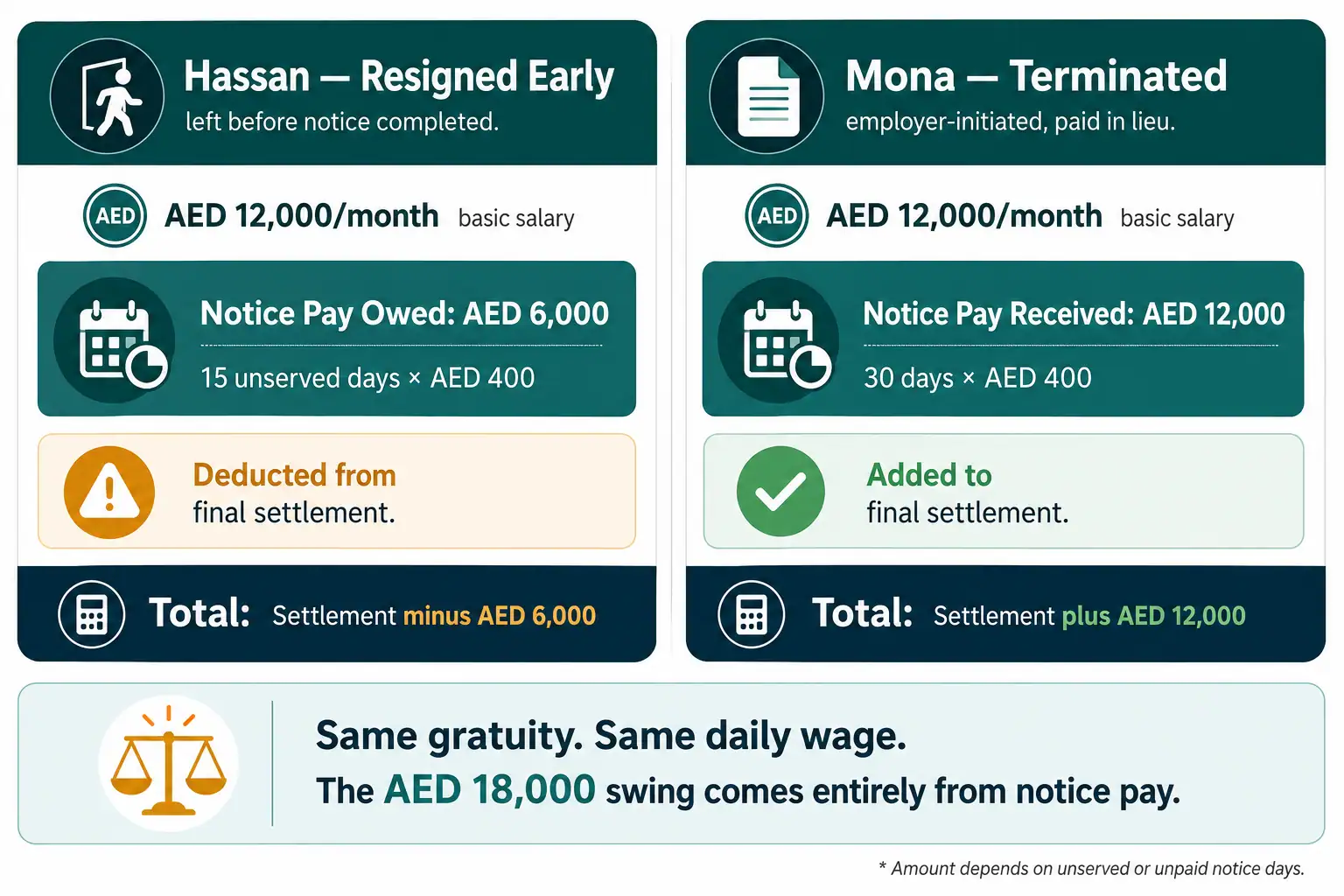
The Key Result: Unlike gratuity, notice compensation is where resignation and termination genuinely diverge in AED terms. How you leave, not why, decides this number. Confirm your exact notice terms with the UAE Notice Period Calculator before you resign or respond to a termination notice.
Quick Checklist Before You Resign or Respond to Termination
Run through this list before you sign anything, whether you are resigning or responding to a termination notice.
- Review your employment contract for your exact notice period and any specific exit clauses.
- Confirm your continuous service length against the 1 year gratuity threshold.
- Check whether your role falls under mainland, DIFC, or ADGM rules.
- If you are resigning, use our UAE resignation letter template and keep a copy of the letter and any related emails.
- Calculate your expected gratuity using the UAE gratuity calculator before signing anything.
- If you believe Article 45 or Article 47 applies to your situation, document the circumstances before your last working day and confirm your case with MOHRE.
Common Mistakes and How to Fix Them
These are the mistakes that cost employees the most money and time during a UAE exit. Most come from assuming one exit type carries different legal weight than the other, when the real risk usually sits somewhere else.
| Common Mistake | Correct Approach |
|---|---|
| Assuming an Article 44 dismissal automatically cancels gratuity | Assuming an Article 44 dismissal automatically cancels gratuity Article 44 covers dismissal without notice for specified serious violations. Request the written dismissal reasons, final-settlement calculation, and legal basis for any deduction. |
| Assuming the 14-day probation notice always applies | Confirm the reason for leaving. An employee leaving the UAE during probation generally gives 14 days’ written notice, while an employee moving to another UAE employer generally gives at least 30 days’ written notice. (U.AE) |
| Assuming any unfair termination qualifies for Article 47 compensation | Article 47 applies specifically where dismissal results from a serious MOHRE complaint or a lawsuit against the employer that is proven valid. It does not apply merely because the termination appears unfair |
| Signing the final settlement before receiving payment | Do not sign a receipt or release stating that payment has been received until the funds have cleared and the settlement calculation has been checked. |
| Assuming the mainland 14-day settlement deadline applies in ADGM | ADGM applies its own employment regulations. Amounts due, excluding qualifying variable payments, must generally be paid within 21 calendar days of the termination date. (ADGM) |
Frequently Asked Questions
Final Word on Termination vs Resignation in the UAE
Termination vs resignation changes less about your gratuity formula than most people assume, and more about which additional protections apply. What differs is your notice obligation, your jurisdiction, and whether the narrow conditions of Article 45 or Article 47 apply to your case. Review your contract, confirm your jurisdiction, and calculate your numbers before you sign anything.
- Federal Decree-Law No. 33 of 2021, as amended by Federal Decree-Law No. 9 of 2024, UAE Legislation Portal (uaelegislation.gov.ae)
- Cabinet Resolution No. 1 of 2022, UAE Legislation Portal (uaelegislation.gov.ae)
- Ministry of Human Resources and Emiratisation (mohre.gov.ae)
- DIFC Employment Law No. 2 of 2019, DIFC official site
- ADGM Employment Regulations 2024, ADGM official site (adgm.com)